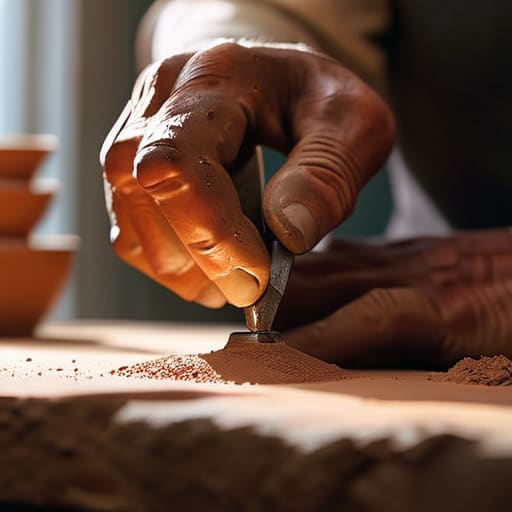
I was sitting at my workbench last Tuesday, the smell of linseed oil heavy in the air, working on the joints of a 1958 teak sideboard. For a moment, the world just… vanished. There was no ping from my phone, no mental checklist of client deliverables, just the tactile resistance of the wood and the steady rhythm of my breathing. That’s a true flow state, but most of the “productivity gurus” online will try to tell you that you need a $500 subscription to a bio-hacking app or a complete sensory deprivation tank to get there. Honestly? That’s just more digital noise designed to sell you a solution to a problem they created.
I’m not here to sell you a new ritual or a complicated stack of software. My goal is to help you strip away the friction that keeps you from doing your best work. I want to share the actual, battle-tested systems I’ve used to protect my focus—the kind that work in the real world, not just in a curated Instagram feed. We’re going to talk about building sustainable environments that allow you to dive deep without the constant fear of being interrupted.
Table of Contents
Mastering Flow State Triggers Without the App Fatigue

Most people think they need a subscription to a new “focus timer” or a complex task manager to get into the zone. They don’t. In my years of restructuring workflows, I’ve seen that the most effective flow state triggers are actually environmental, not digital. It’s about controlling your immediate surroundings to minimize friction. If your desk is a graveyard of half-finished projects and your phone is buzzing every three minutes, no app in the world is going to save your concentration. You need to curate a physical space that signals to your brain that it’s time to work, not react.
Instead of hunting for the perfect software, lean into proven deep work techniques like time-blocking or the “single-tasking” rule. I personally find that clearing my physical workspace—much like sanding down a piece of old walnut before a finish—sets the mental stage. When you strip away the digital clutter, you stop fighting your tools and start utilizing your own cognitive capacity. It’s not about adding more layers of technology; it’s about removing the obstacles that prevent you from achieving that effortless sense of immersion.
Deep Work Techniques That Actually Protect Your Time

The problem with most advice on deep work is that it assumes you have an infinite supply of willpower. You don’t. If you try to force concentration while your inbox is pinging every thirty seconds, you’re just setting yourself up for burnout. Instead of relying on grit, you need to build structural boundaries that do the heavy lifting for you. This means more than just turning off notifications; it means scheduling your most demanding tasks during your natural peak energy windows. If you’re a morning person, guard those first three hours like your career depends on it.
I’ve seen too many professionals try to use complex software to manage their attention, but real cognitive performance enhancement comes from simplicity. Try the “Time Blocking” method, but with a twist: don’t just block the task, block the environment. Clear your desk, put your phone in another room, and commit to a single objective. When you reduce the friction between your intention and your action, you stop fighting your brain and start leveraging it. It’s about creating a predictable rhythm that allows for true mental immersion.
Five Practical Ways to Guard Your Focus
- Stop treating your notifications like emergencies. If you’re in the middle of something meaningful, a ping from a Slack channel or a random email is just noise. Put your phone in another room or use a strict “Do Not Disturb” setting. You can’t find flow if you’re constantly being pulled back to the surface.
- Designate a specific “work zone” that signals to your brain it’s time to perform. It doesn’t have to be a dedicated office; it could just be a specific chair or even a particular desk lamp you turn on. When that physical cue is present, your brain knows the shallow work is over.
- Audit your task list for “micro-distractions.” We often lose flow because we try to jump from a heavy, complex project straight into a quick email check. Instead, batch those small, administrative chores into a single time block so they don’t bleed into your deep work sessions.
- Match the difficulty to your skill level. If a task is too easy, you’ll get bored and drift; if it’s too hard, you’ll get frustrated and quit. The sweet spot—the flow state—lives right at the edge of your capability. Adjust the scope of your work to hit that tension point.
- Build in “buffer time” between intense sessions. You aren’t a machine, and you can’t maintain peak cognitive output for eight hours straight. Give yourself fifteen minutes to just sit, grab a coffee, or stare out the window without a screen. It clears the mental residue so you can dive back in properly.
The Bottom Line: Systems Over Software
Stop looking for a “magic” app to fix your focus; flow is a byproduct of a clear environment and a predictable routine, not a subscription service.
Protect your deep work blocks with ruthless intensity—if you don’t defend your time, someone else will gladly spend it for you.
Real productivity isn’t about doing more things; it’s about creating the structural space necessary to do the right things without constant mental friction.
The Real Cost of Chasing Productivity
“Stop looking for a magic app to unlock your focus. Flow isn’t something you download; it’s what happens when you finally stop fighting your environment and start building systems that respect your attention.”
Emmett Kowalski
The Long Game of Focus
At the end of the day, finding your flow isn’t about finding a magic piece of software or a revolutionary new biohack. It’s about the unglamorous work of setting boundaries, clearing the digital clutter, and building a predictable environment where your brain feels safe enough to dive deep. We’ve covered how to trigger that state without getting lost in app fatigue and how to use deep work techniques to defend your time. If you can master these foundational systems, you stop reacting to the chaos and start actually directing your energy toward the work that moves the needle.
Don’t let the pursuit of perfect productivity become just another source of stress. I’ve spent years watching professionals burn out trying to optimize every single second of their day, only to realize they’ve optimized the joy right out of it. Real efficiency isn’t about doing more; it’s about making space for what matters most. Use these tools to reclaim your mental bandwidth, then step away from the screen. The goal isn’t to live in a constant state of high-performance output—it’s to build a life where you have the clarity to work intensely when it counts, and the peace to truly rest when it doesn’t.
Frequently Asked Questions
How do I know if I'm actually in a flow state or if I'm just hyper-focusing on a meaningless task?
It’s a fine line, and honestly, most people mistake frantic busywork for real progress. The litmus test is how you feel when you finally emerge. Hyper-focus on a meaningless task usually leaves you feeling drained, scattered, or even a bit hollow—like you’ve just been spinning your wheels in the mud. Real flow feels different. It’s a sense of effortless mastery. You feel energized, not just exhausted, because you were actually moving the needle.
What do I do when an urgent, "real world" interruption breaks my concentration mid-flow?
The “emergency” is rarely an emergency; it’s usually just loud. When a real-world interruption hits, don’t fight it—that’s how you lose the mental thread entirely. Instead, use a “bridge note.” Grab your notebook and jot down exactly where your brain was and the very next step you intended to take. It takes ten seconds, but it gives your brain a landing pad to return to once the chaos subsides.
Can I actually train my brain to enter flow more quickly, or is it just something that happens when the mood strikes?
It’s not just a lightning strike of inspiration; it’s a skill you can sharpen. Think of it like warming up an engine. You can’t just turn the key and expect a smooth ride if you’ve been idling in distractions all morning. By standardizing your pre-work rituals—like clearing your physical desk or using the same focus playlist—you signal to your brain that it’s time to shift gears. You’re building a predictable pathway to focus.
